Social comparison is generally most potent for the young.
A 2015 study by researchers at the universities of Essex and Cambridge showed that the tendency to engage in comparison declines across one’s lifespan.
One reason, they hypothesized, is that as we age, we’re more likely to evaluate ourselves against the yardstick of our own past rather than the present state of others.
Additionally, teenagers have a wide variety of regions in the brain that seek and deliver social rewards, including the part of the striatum called the nucleus accumbens, that becomes supercharged at the adolescent transition.
(See the visual aid below to see where the striatum and nucleus accumbens are located in the brain.)
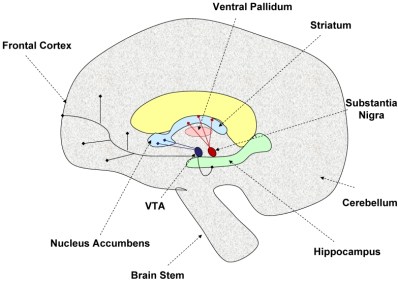
The use of social media, which is also primarily used by youth, triggers the release of dopamine from the striatum and nucleus accumbens within the brain.
This is alarming because the same areas of the brain that are active and release dopamine from the use of social media do the same when alcohol or cigarettes are used.
The impressionable and often insecure time frame for adolescents mixed with the addictive nature of social media is a dangerous catalyst for continued comparison.
 Elizabeth Beeli