You’ve always wanted a private chef who could manufacture something incredible out of a few ingredients.
And you have no shortage of supply with a stocked pantry and fridge.
Distributing food to the table? We’ll leave that to the younger siblings.
And maybe one day you can open a space where people can come and enjoy this amazing chef’s creation, your own version of Gusteau’s!
Said another way:
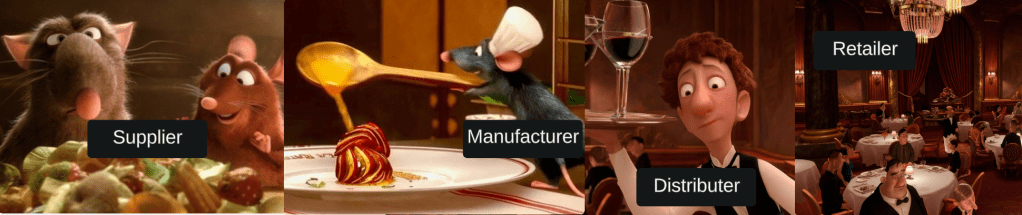
Yes maybe it’s a bit of a stretch to say the rats are suppliers here but…we’ll assume they were scouring with Michelin star palettes that day.
Suppliers
Suppliers provide the raw materials (pineapples), components (buttons and cotton), or services (delivering the raw goods) to the manufacturers so they can create a product.
Example: Intel or Samsung supply computer chips to other manufacturers.
Manufacturers
Role: Manufacturers buy from suppliers and turn raw materials into finished goods that are certified and ready to be sold.
Example: Most car companies (Toyota, Ford, GM) buy parts from various suppliers (Bosch for electronics, Bridgestone for tires) to build their car.
Distributors
Role: They handle the storage, transportation, and distribution of goods.
Sometimes the manufacturer manages distribution in-house, outsources to a third party or chooses a hybrid of both.
1. In-House Distribution
When: High Volume / Established Companies
Why: Control, efficiency, and long-term savings.
Examples by Industry:
- CPG (Consumer Packaged Goods): PepsiCo operates its own fleet for snack and beverage distribution.
2. Outsource Distribution
When: Low Volume / Regional Markets
Why: Focus on production and save costs.
Examples by Industry:
- Automotive: Use of regional distributors or dealerships for vehicle sales and logistics.
- Fashion: A small handbag company might partner with distributors to sell products to Nordstrom or other retailers.
- Agriculture: Local organic farms often partner with regional distributors to deliver produce to grocery stores.
3. Hybrid Approach
When: For flexibility and specialization.
Why: Combine in-house control with outsourced expertise for specific needs.
Examples by Industry:
- Food & Beverage: Nestlé outsources refrigerated transport for perishable goods while handling dry goods in-house.
Retailers
Role: Retailers are the final link between the supply chain and consumers. They sell products directly to end-users.
Companies that own manufacturing, distribution, and retail: IKEA, Costco, Tesla, Nike, Apple
Companies that are primarily retailers: Home Depot, 7-Eleven, Foot Locker, Nordstrom
 Elizabeth Beeli